
In modern conference rooms, hybrid workplaces, distance learning environments, and unified communication systems, clear voice transmission is essential for productive conversations. However, when sound from a loudspeaker is picked up again by a local microphone and transmitted back to the far-end participant, an unwanted echo is created. This acoustic echo can interrupt conversations, reduce speech intelligibility, and create an unprofessional meeting experience.
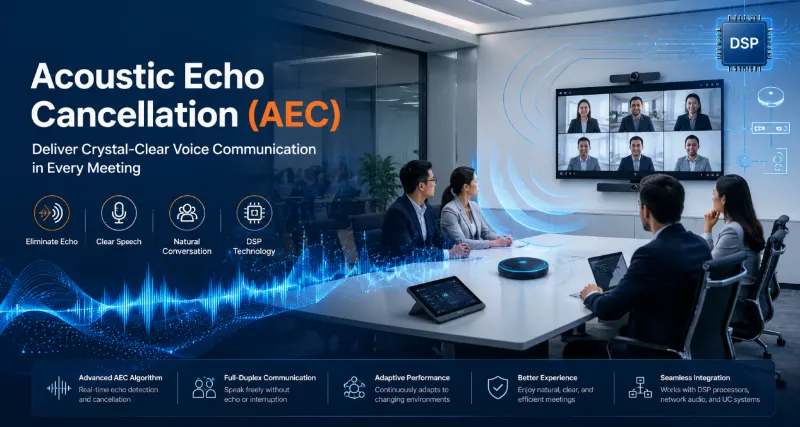
Acoustic Echo Cancellation (AEC) is an advanced Digital Signal Processing (DSP) technology designed to eliminate this problem. By identifying and removing unwanted acoustic echoes in real time, AEC enables smooth full-duplex communication, allowing participants at both ends of a conversation to speak naturally without hearing distracting echoes.
Today, AEC has become a standard feature in professional conference audio systems, DSP processors, USB conference devices, video conferencing platforms, and networked audio solutions.
Before understanding AEC, it is important to understand how acoustic echo is generated.
In a typical conference room, the voice of a remote participant is reproduced through loudspeakers. The sound propagates through the room, reflects from walls, ceilings, tables, and other surfaces, and is then captured by local microphones. Without echo cancellation, this reflected sound is transmitted back to the remote participant, who hears their own voice a short time later.
Unlike network latency, acoustic echo is caused by the physical acoustic environment and becomes more noticeable in larger rooms with multiple loudspeakers, ceiling microphones, or long reverberation times.
Common causes of acoustic echo include:
· Conference loudspeakers located close to microphones
· Highly reflective meeting rooms
· Large conference tables
· Ceiling microphone arrays
· High speaker volume
· Hybrid meeting systems with simultaneous local and remote participants
Even a delay of only a few hundred milliseconds can significantly affect conversation quality and make meetings uncomfortable.
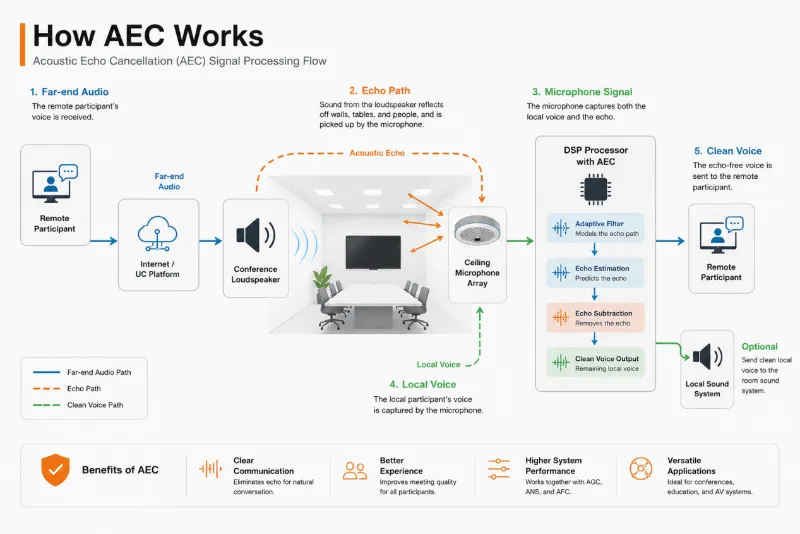
AEC continuously monitors both the loudspeaker output signal and the microphone input signal.
The DSP processor receives a reference copy of the signal sent to the loudspeakers. Using adaptive filtering algorithms, it predicts how that signal will travel through the room and estimates the echo that will be captured by the microphones. The estimated echo is then removed from the microphone signal before audio is transmitted to remote participants.
Because room acoustics constantly change as people move, doors open, or furniture is rearranged, modern AEC algorithms continuously adapt to the acoustic environment in real time.
A typical AEC processing workflow includes:
1. Receive the far-end audio reference signal.
2. Model the room's acoustic characteristics.
3. Estimate the returning echo.
4. Compare the estimated echo with the microphone signal.
5. Remove the echo while preserving the local speaker's voice.
6. Output clean near-end speech for transmission.
This adaptive processing enables natural full-duplex conversations without requiring users to mute microphones when others are speaking.
AEC allows both local and remote participants to speak simultaneously without hearing distracting echoes, creating a more natural conversation.
Removing acoustic echo significantly improves speech clarity, making conversations easier to understand during meetings, lectures, and presentations.
Participants no longer need to manually mute microphones or adjust speaker volume to prevent echo, resulting in smoother and more productive meetings.
AEC works together with other DSP technologies to deliver professional-grade voice quality even in acoustically challenging environments.
Professional DSP processors with built-in AEC simplify system design by reducing the need for additional external processing equipment.
Many people confuse AEC with other DSP functions. Although they work together, each technology addresses a different audio problem.
|
Technology |
Primary Purpose |
|
AEC (Acoustic Echo Cancellation) |
Removes loudspeaker audio that is picked up by microphones and sent back to remote participants. |
|
ANS (Automatic Noise Suppression) |
Reduces constant background noise such as HVAC systems, fans, or office ambience. |
|
AFC (Automatic Feedback Suppression) |
Prevents acoustic feedback (howling) caused by microphone-to-speaker loops within the same room. |
|
AGC (Automatic Gain Control) |
Automatically adjusts microphone sensitivity to maintain consistent voice levels. |
|
ARR (Automatic Reverberation Reduction) |
Minimizes excessive room reverberation to improve speech intelligibility. |
Together, these technologies create a complete voice enhancement solution for modern conference audio systems. FHB's conference microphone products such as the CM80D and MC3200 integrate AEC, AFC, ANS, AGC, ARR, beamforming, and other DSP algorithms to improve speech pickup and conferencing performance.
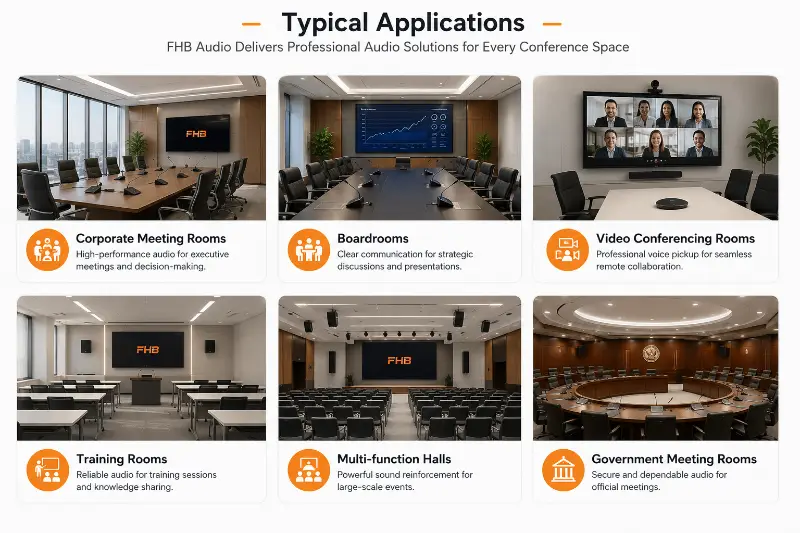
Acoustic Echo Cancellation is widely used wherever clear two-way voice communication is required.
Typical applications include:
· Corporate conference rooms
· Executive boardrooms
· Hybrid meeting spaces
· Government meeting rooms
· Courtrooms
· Distance learning classrooms
· Lecture halls
· Telemedicine facilities
· Command and control centers
· Video conferencing systems
· Networked AV installations
· Unified communication systems
As organizations continue adopting hybrid collaboration, reliable AEC has become a fundamental requirement rather than an optional feature.
FHB Audio integrates professional Acoustic Echo Cancellation technology into a range of conference audio products designed for commercial AV environments.
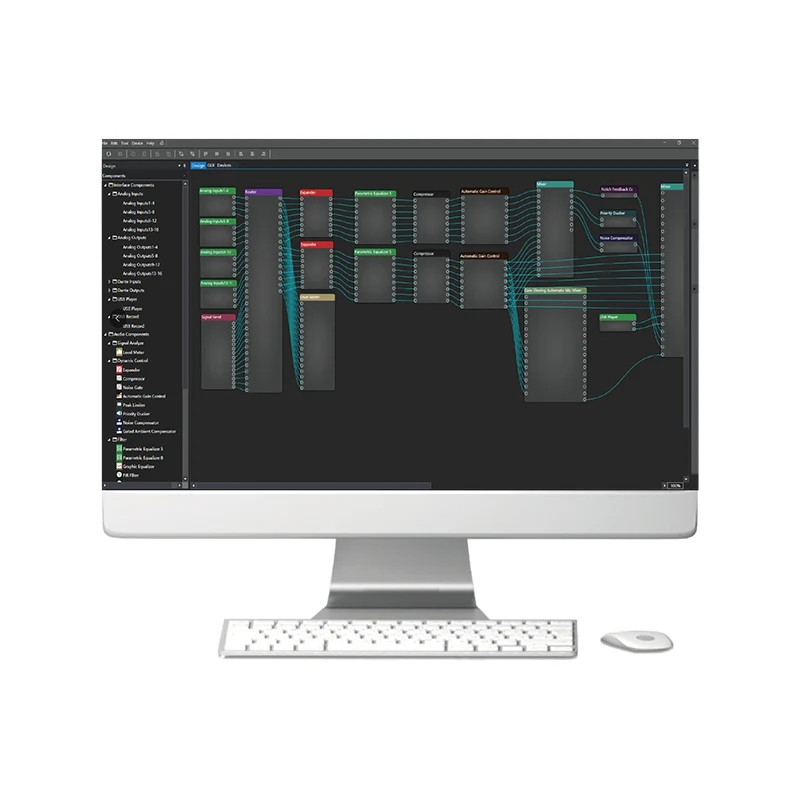
Our conference DSP processors and array microphone systems combine AEC with Automatic Noise Suppression (ANS), Automatic Gain Control (AGC), Automatic Feedback Suppression (AFC), Automatic Reverberation Reduction (ARR), beamforming, and intelligent DSP processing to deliver clear, natural voice communication.
Representative products include:
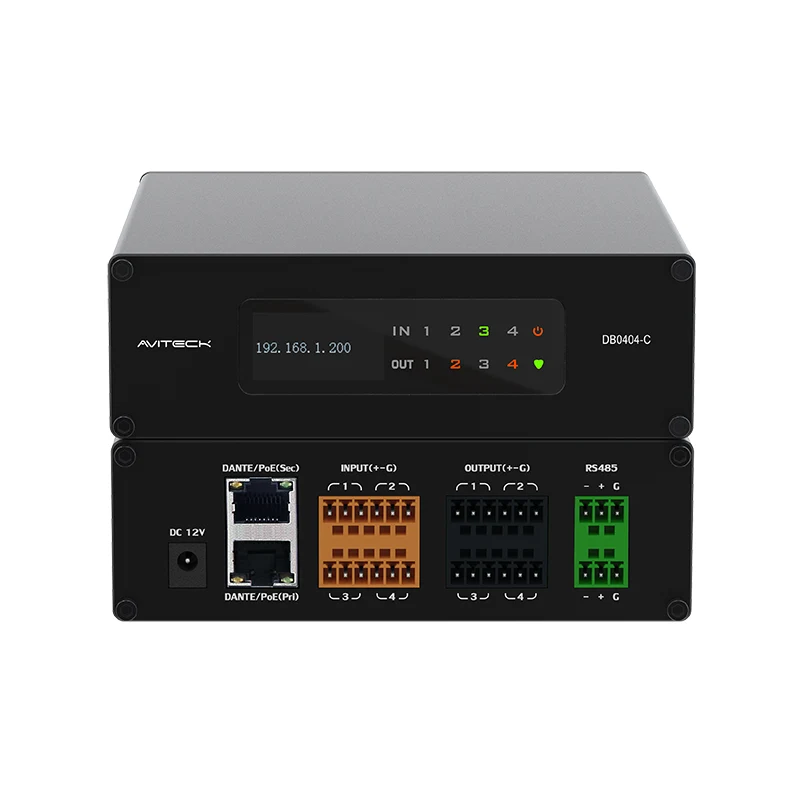
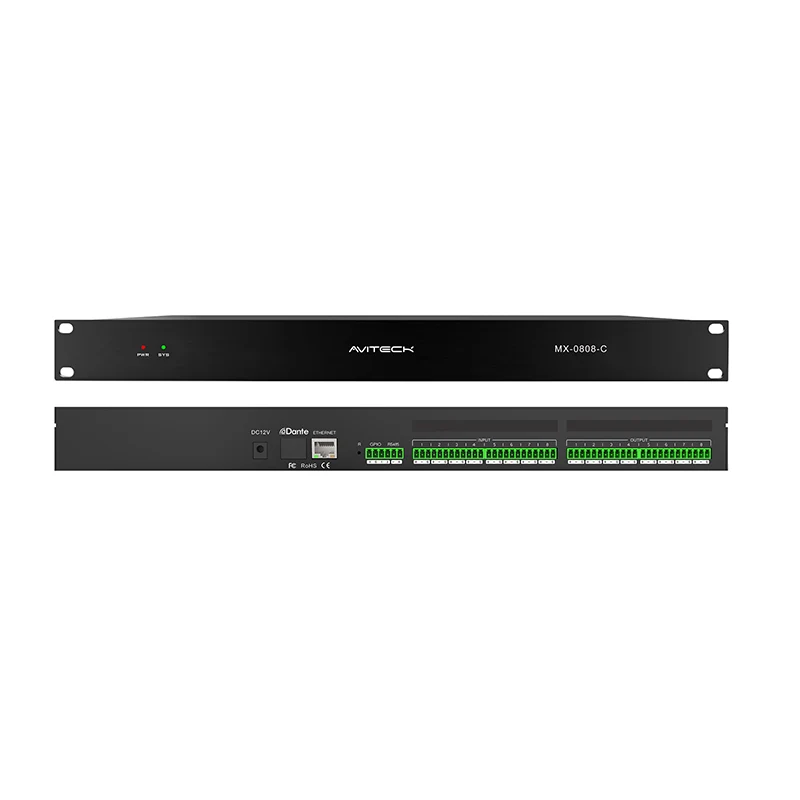
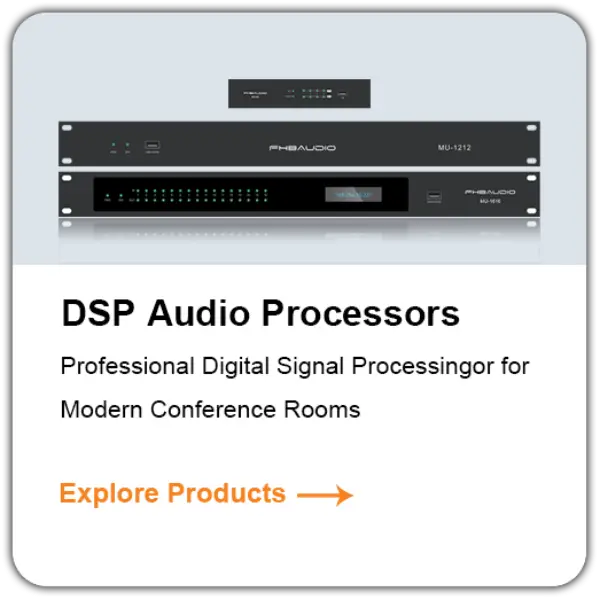
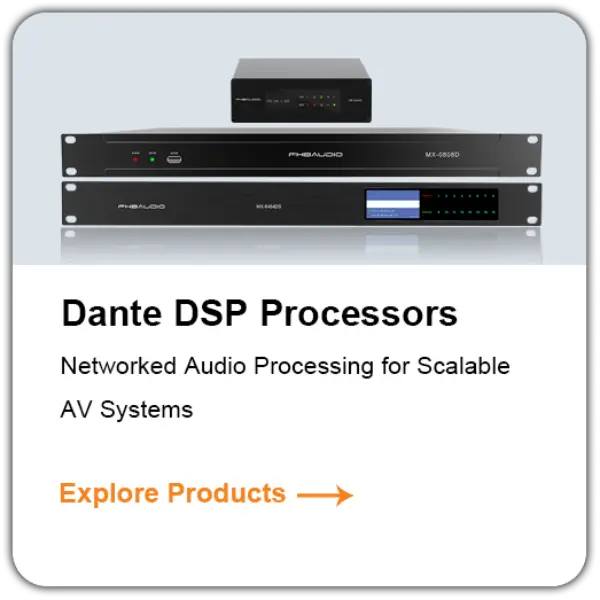
· MU Series Dante Digital Audio Matrix Processors
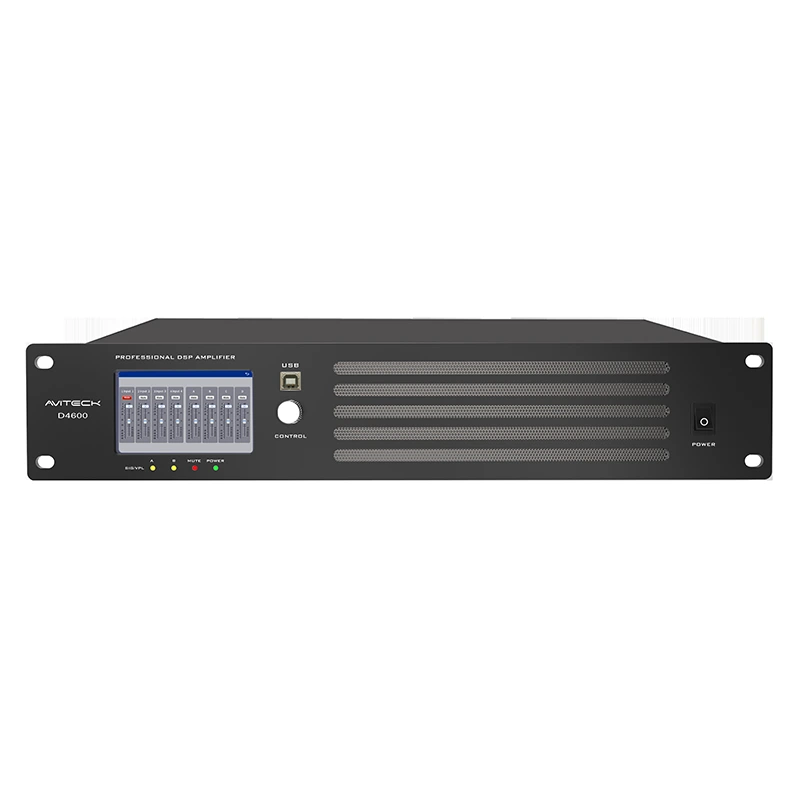
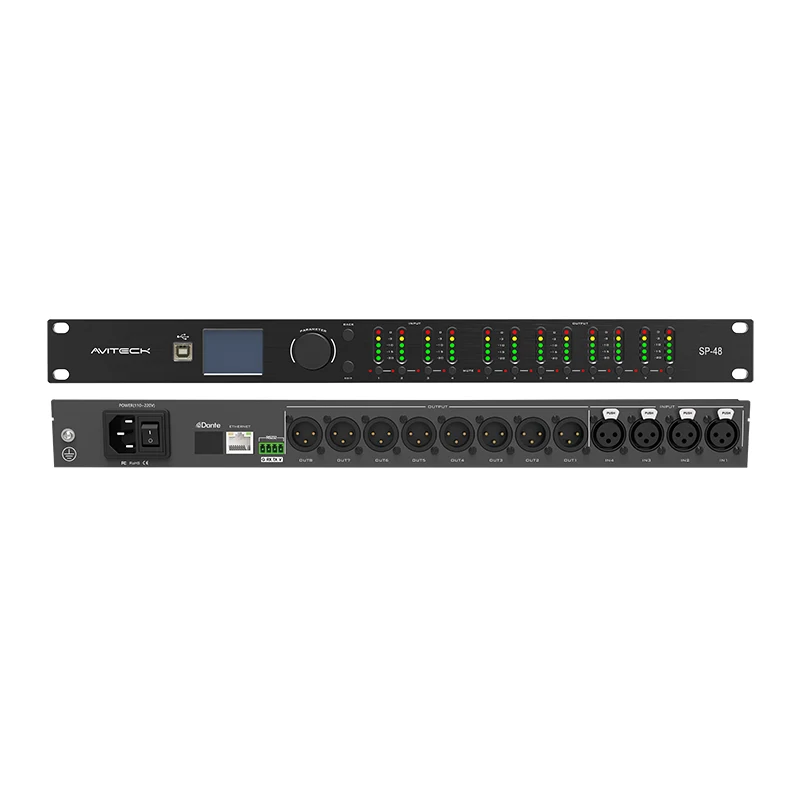
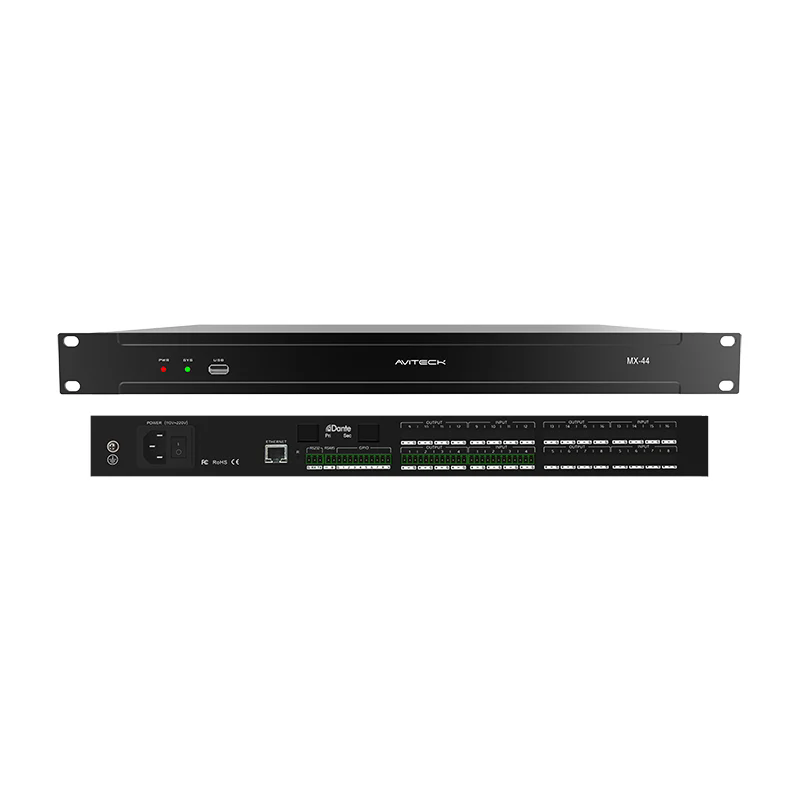
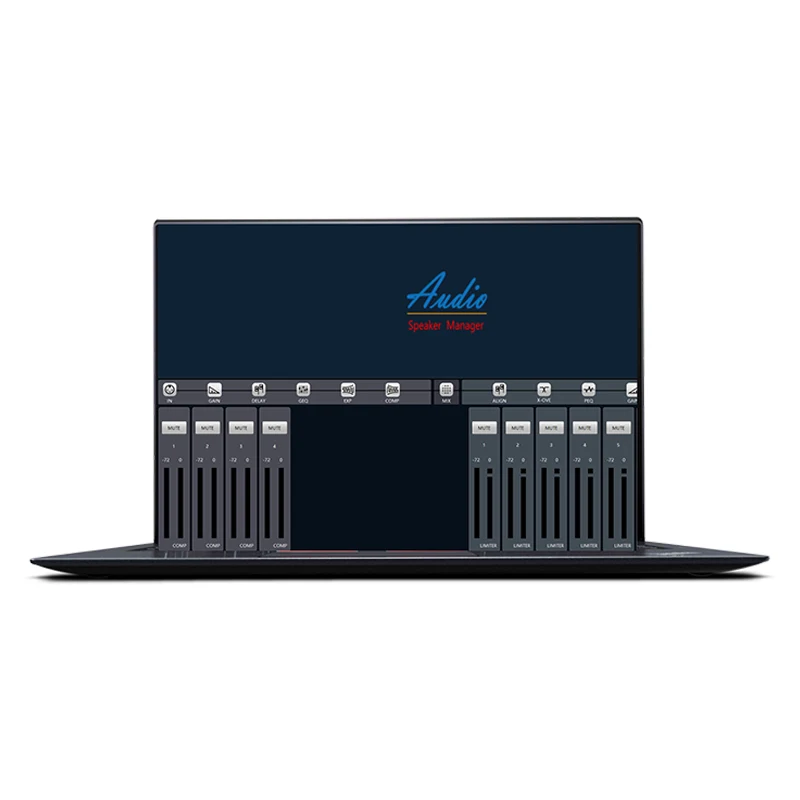
· DSP Series Speaker Management Processors
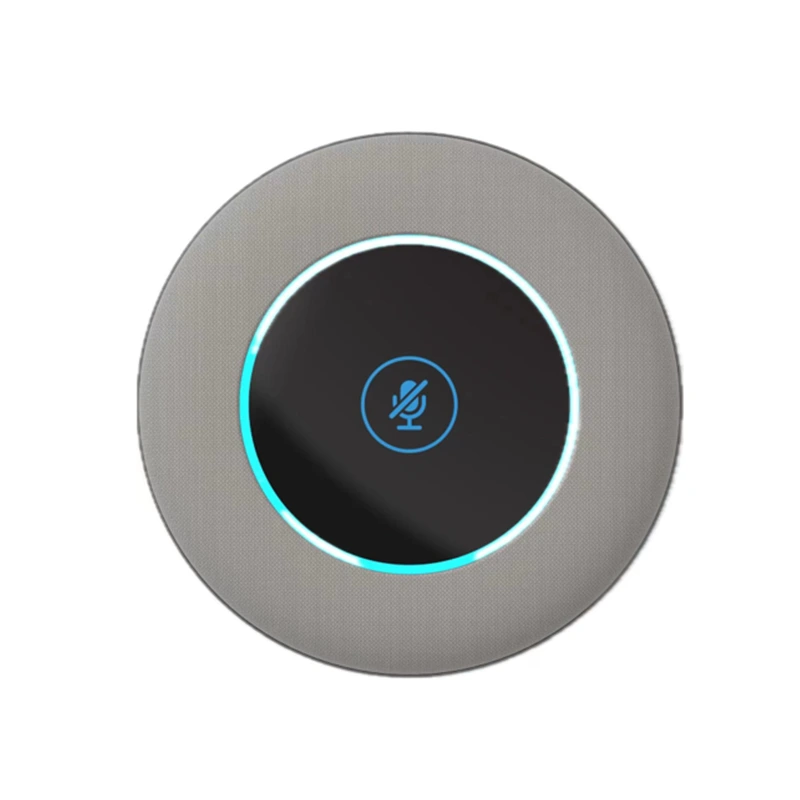
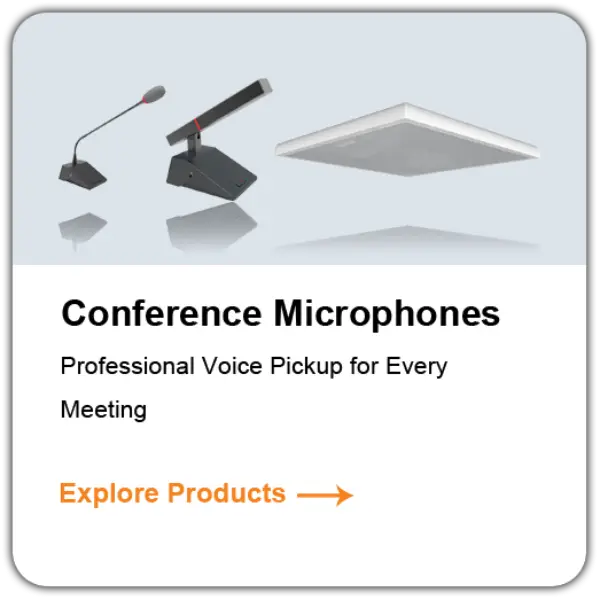
· CM80D Dante Array Microphone
· MC3200 Ceiling Array Microphone
These solutions are suitable for conference rooms, government facilities, educational institutions, corporate campuses, and other professional communication environments where voice quality is critical. The CM80D supports up to 6 m pickup, while the MC3200 uses a 32-element array with up to 20 m pickup distance, both featuring integrated AEC and related DSP functions.
Acoustic Echo Cancellation is one of the most important technologies in modern conference audio systems. By intelligently removing echoes generated between loudspeakers and microphones, AEC enables natural, full-duplex conversations with excellent speech clarity and improved meeting efficiency.
Whether designing a small meeting room or a large enterprise collaboration system, selecting DSP solutions with high-performance AEC is essential for delivering a professional communication experience.
· MU Series Dante Digital Audio Matrix
· DSP Series Speaker Management Processor
· CM80D Dante Array Microphone
· MC3200 Ceiling Array Microphone
· How Does Acoustic Echo Cancellation Work?
· Why Conference Rooms Need AEC
· AEC vs ANS vs AFC: What's the Difference?
· How DSP Improves Speech Intelligibility
· Understanding Beamforming Microphone Technology